
RESULTS FROM A GLOBAL SURVEY

A Joint Study from the AMA Center for Digital Health & AI and Medscape
Which physicians are ready to act on wearable-enerated data?
Where does skepticism about accuracy or liability actually come from?
This study answers those questions directly, physician by physician, country by country, specialty by specialty.
Four findings that shape the gaps in education
Download the Clinical Insights Report of the joint AMA and Medscape study to see where the education gaps in wearables are:
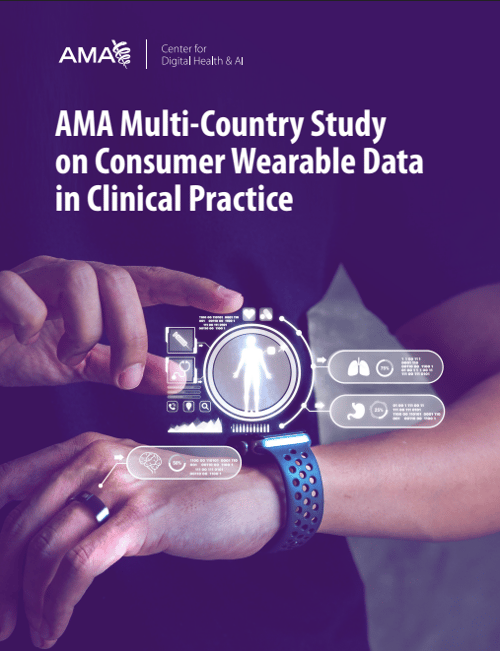
A Report to Inform Future Education
Evidence generation strategy
See which evidence types actually move physicians from skeptical to confident, before you commit to an RWE or outcomes study built on wearable-derived endpoints.
HCP education and grant planning
Country- and specialty-level barrier data gives you a defensible, AMA-validated starting point for where an independent medical education grant closes a real gap.
Digital biomarker and patient-support programs
Understand the workflow and liability friction physicians face before your program asks them to act on wearable data in practice.
Research at a Glance
The gap between exposure and integration is where education lives. This report tells you why the gap exists in each market and which physicians are closest to closing it.
of physicians see a real clinical advantage for patient care
"Realizing the full potential of wearable technologies will require the infrastructure, trust, and collaboration needed to translate a growing stream of information into meaningful clinical insight.”
Frequently Asked Questions
What is the AMA Multi-Country Study on Consumer Wearable Data in Clinical Practice?
It's a first-of-its-kind, independent international survey conducted by Medscape in partnership with the AMA Center for Digital Health & AI. It examines how physicians across six countries — the US, Canada, France, Germany, Spain, and the UK — interact with consumer-grade wearable devices (like smartwatches, fitness trackers, and biosensors) in clinical practice, and what's holding back broader adoption.
What are the headline findings?
Physicians are ready — the workflow isn't. 82% of physicians personally use a wearable device, and 77% see a real clinical advantage for patient care. Yet fewer than 6% of physicians in any country have fully integrated wearable data into their clinical workflows. The gap is structural, not motivational.
Which specialties offer the strongest opportunity for education support?
Cardiology and endocrinology are the strongest near-term target physicians. They review wearable data most often, see the most clinical value, and rate it most feasible to use in a routine visit. Primary care, neurology, and pulmonology show real interest but face more friction, making them good targets for a second-wave or more foundational curriculum.
If physicians already believe in wearables, why isn't adoption higher?
Physicians cited five consistent barriers: confidence interpreting the data, integrating it into existing workflows, a lack of outcomes evidence, unclear or absent reimbursement, and concerns about medical-legal liability. These are systemic and structural issues, not a lack of physician interest or awareness.
Why should we prioritize wearable-data education now?
The gap is proven and current: 82% of physicians use wearables personally and 77% see real clinical value, but under 6% have integrated the data into their workflow anywhere. That's a wide, documented readiness gap — exactly the kind CME is designed to close, and a rare case where the case is data-backed rather than assumed.
What specific content gaps can education fill?
Five, directly from the data: building confidence interpreting wearable data, applying evidence in clinical decisions, integrating data into workflow, communicating results (and false positives) to patients, and addressing liability/implementation concerns. These map cleanly to CME modules rather than requiring us to guess at physician needs.
Why should we trust this data enough to build a strategy on it?
It's independent data, not sponsor-driven. A joint AMA Center for Digital Health & AI / Medscape survey of 2,222 physicians across six countries, positioned explicitly as an unbiased pulse on physician readiness rather than a vendor- or company-funded study. That independence is what makes it defensible as the basis for an education strategy.
Why activate this through Medscape specifically?
Medscape is the only party in this partnership that converts the research into reach and behavior change: AMA supplies physician credibility and practice insight, Medscape supplies distribution across 30+ specialty education destinations to millions of clinicians. That's the "research-to-education continuum" — insight to activation, not just a published report sitting on a shelf.